Pigfolio

Pigments through history

When each pigment arrived, from cave-painting earths to modern pyrroles, and famous paintings where scientists have found them.

Every tube on your palette has a history. Some pigments are older than writing; some were invented by accident; a few were so poisonous or unstable that they disappeared. Here's when each one arrived, and famous paintings where scientists have found it.

Timeline

Earths and mineralsPrehistory to 1400
The old masters1400 to 1700
The chemistry boom1700 to 1900
Modern pigments1900 to today

Point at a pigment to name it, and click to read about it. Faded hexagons are no longer made.

Seen in famous paintings

Each of these has been studied by conservation scientists, who identified the pigments from tiny samples, X-rays or spectroscopy. Follow a source to read the analysis.

Self-Portrait at the Age of 34 by Rembrandt van Rijn, 1640
Self-Portrait at the Age of 34Rembrandt van Rijn, 1640. Oil on canvas. National Gallery, London.Ochres, siennas and umbersBone and ivory blackLead whiteVermilionA tiny palette: red and yellow ochres, bone and charcoal black, lead white, a touch of vermilion in the flesh, and a red lake in the dark cloak. Almost everything glowing in this face is earth and white.Source: ColourLex, after Bomford et al., Art in the Making: Rembrandt (2006). Image: Public domain, via Wikimedia Commons.
The Milkmaid by Johannes Vermeer, About 1658
The MilkmaidJohannes Vermeer, About 1658. Oil on canvas. Rijksmuseum, Amsterdam.Natural ultramarineLead whiteLead-tin yellowThe blue of the apron and tablecloth is natural ultramarine from lapis lazuli, mixed with lead white and then glazed with more ultramarine. The yellow sleeves are lead-tin yellow shaded with ultramarine. Vermeer spent lavishly on this blue.Source: ColourLex, after Rijksmuseum research. Image: Public domain (Rijksmuseum), via Wikimedia Commons.
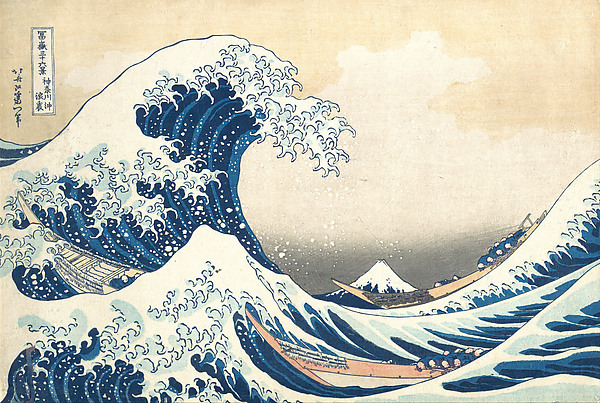
The Great Wave off Kanagawa by Katsushika Hokusai, About 1830–32
The Great Wave off KanagawaKatsushika Hokusai, About 1830–32. Woodblock print. The Metropolitan Museum of Art, New York.Prussian blueNot an oil painting, but the most famous showcase of Prussian blue. The pigment had only just become affordable in Japan, and the publisher advertised the series for its new blue. The Met's scientists found the printers combined it with traditional indigo.Source: The Met: The Great Wave, anatomy of an icon. Image: The Met, Open Access (public domain).
The Gare St-Lazare by Claude Monet, 1877
The Gare St-LazareClaude Monet, 1877. Oil on canvas. National Gallery, London.Cobalt blueCerulean blueSynthetic (French) ultramarineViridianEmerald greenVermilionLead whiteMonet made his smoky blues and purples with almost no black: cobalt and cerulean blues, synthetic ultramarine, viridian and emerald green, mixed with a red lake and lead white. The white steam is pure lead white.Source: ColourLex, after Bomford et al., Art in the Making: Impressionism (1990). Image: Public domain, via Wikimedia Commons.
A Wheatfield, with Cypresses by Vincent van Gogh, 1889
A Wheatfield, with CypressesVincent van Gogh, 1889. Oil on canvas. National Gallery, London.Zinc whiteCobalt blueViridianChrome yellowEmerald greenVermilionSynthetic (French) ultramarineA tour of the new 19th-century colors: clouds of pure zinc white, a sky of cobalt blue, viridian in the turquoise, chrome yellow wheat, emerald green bushes and vermilion poppies.Source: ColourLex, after Leighton et al., National Gallery Technical Bulletin 11. Image: Public domain, via Wikimedia Commons.
Sunflowers by Vincent van Gogh, 1889
SunflowersVincent van Gogh, 1889. Oil on canvas. Van Gogh Museum, Amsterdam.Chrome yellowVan Gogh used two kinds of chrome yellow here. X-ray studies found the paler, sulfur-rich kind slowly darkening toward olive-brown where light reaches it. The change isn't visible yet, but it shows why light exposure matters even for famous paintings.Source: University of Antwerp: why Van Gogh's Sunflowers are wilting (Monico et al., 2015). Image: Public domain, via Wikimedia Commons.
The Scream by Edvard Munch, About 1910
The ScreamEdvard Munch, About 1910. Tempera and oil on cardboard. Munch Museum, Oslo.Cadmium yellow and orangeThe yellows of the sky are an early, impure cadmium sulfide. Scientists found it breaking down into a pale sulfate, and that damp air, not light, is the main cause. The researchers recommended keeping it in drier air.Source: MUNCH: researchers have found out why The Scream is fading. Image: Public domain, via Wikimedia Commons.

Pigments by era

Earths and mineralsPrehistory to 1400

The first paints were dug from the ground or burned in a fire: colored clays, charred bone, ground minerals. A few rare ones, like lapis lazuli and cinnabar, were traded across continents.

Madder lake

Antiquity

A transparent red dyed onto a mineral base from the root of the madder plant. Glazed over other colors it gave old master reds their depth. It fades in strong light, and its colorant was the first natural dye ever made synthetically (see alizarin).

Natural ultramarine

About 600 CE

Ground from lapis lazuli mined in Afghanistan, where it was painted in cave temples by the 7th century. In Renaissance Europe it cost more than gold, and contracts specified how much a painter had to use. Today's PB29 is almost always the synthetic version (see below).

Found inThe Milkmaid, Vermeer

The old masters1400 to 1700

Oil painting took over in Europe, but the palette barely changed: earths, lead white, black, vermilion, a few lakes and precious blues. Painters like Rembrandt made whole careers from a handful of them.

Smalt

1500sNo longer made

Ground blue glass colored with cobalt: a cheap stand-in for ultramarine that Rembrandt used. It loses its color in oil over time, which is why some old skies have turned grey.

Unstable in oil, and cobalt blue does the same job far better.

Use instead:PB28 Cobalt Blue35

Naples yellow

1700s

Lead antimonate, a warm, opaque, pale yellow known from ancient glass and common on palettes from the 1700s. Genuine Naples yellow is toxic and rare now; most tubes with the name are hues mixed from white and other yellows.

The chemistry boom1700 to 1900

Chemists started making colors that nature never offered: Prussian blue by accident, then cobalt, chrome, cadmium and synthetic ultramarine. Sold ready-made in the new collapsible tin tube, they gave the Impressionists their brightness.

Cobalt green

1780

One of the first cobalt colors, a pale, weak green that was always expensive. It's still made, but mainly for its gentle, cool tint.

Cobalt violet

1859

The first stable violet pigment, delicate and expensive. Monet loved it. Early versions contained arsenic; today's are cobalt phosphate.

Aureolin

1860s

Cobalt yellow: a transparent, cool yellow popular with watercolorists. It's prone to fading and darkening in oil, and most painters now use a transparent arylide or nickel azo yellow instead.

Alizarin crimson

1868

Two German chemists worked out how to make madder's colorant, alizarin, from coal tar: the first natural dye ever made in a lab. It quickly replaced madder. It fades in thin layers, and quinacridones and pyrroles now do its job better.

Modern pigments1900 to today

Organic chemistry brought intense, lightfast colors at a fraction of the old prices. Most of the tubes on sale today are built on pigments invented in the last hundred years.

Cadmium red

1910s

Cadmium selenide finally gave painters a strong, opaque red that didn't darken like vermilion. It has been the standard warm red ever since, though pyrrole reds now offer a cadmium-free alternative.

Titanium white

1920s

The brightest, most opaque white, and non-toxic. It went into paint in the 1920s and is now by far the most common white on artists' palettes.

Sources and image rights

Dates are approximate first use by painters; many pigments existed earlier in other crafts. They follow the standard references below. Every painting shown has a published technical analysis, linked from its card.

All images are of works in the public domain, from museum open-access programs and Wikimedia Commons. Museums named here don't endorse Pigfolio.

Open all 1,492 in Explore to filter, sort, compare and save them.